$50 Off First Visit for New Clients

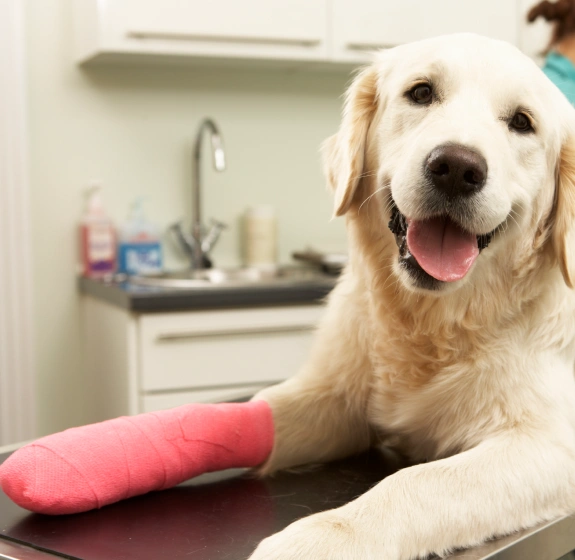
Post Cruciate Surgery Rehab for Pets
Recovering from cruciate ligament surgery is a journey—and physical therapy plays a vital role in helping your pet regain strength, mobility, and comfort. Whether your pet has undergone TPLO, TTA, or another type of cruciate ligament repair, a structured rehabilitation plan can make a significant difference in the healing process.
The first 14 days after surgery (starting on day 1)
Cold Therapy
Apply ice or frozen peas (not gel packs) to all sides of the knee for 15 minutes, 3–4 times daily and after PROM to reduce pain and swelling.
Passive Range of Motion (PROM)
Dr. Sickels has 27 years of experience in small animal practice and devotes much of her time to behavior consultations.
Massage
Boosts circulation and reduces muscle scarring.
Massage the thigh muscles (front and back) from knee to hip for 2–3 minutes before and after PROM.
Walking
Maintains strength and mobility.
Do slow, controlled leash walks for 5–10 minutes, twice daily. Avoid hills and stairs early on.


Weeks 2-4
- Continue PROM and massage.
- Increase length of walks gradually to 15-20 minutes twice daily by week.
- Ice after PROM and walks.
- Stay slow and controlled!
Weeks 5-8
- Continue slow, controlled leash walks. Gradually increase to 20-30 minutes per walk. Add the following while walking to build strength:
- Walk your dog in a figure 8 pattern to the left and right. Start with a large figure 8 and walk the pattern 5 times in one direction before changing to the other direction. Over 3-4 weeks gradually tighten the figure 8 and switch directions more frequently.
- Do sit-to-stand exercises. Stand your dog alongside a wall with the operated leg against the wall and ask him to sit and then to stand several seconds later. Try to prevent your dog from walking forward when standing up to make this more difficult. Start with 3-4 repetitions 2-3 times a day and build to 10 reps.
- Continue PROM, massage, and ice.
After the second month add some of the following:
- Continue all above exercises for strength and range of motion.
- Add uphills, snow or grass to walks.
- Slowly go up and down stairs
- Set up a line of cones or obstacles and zig-zag through them.
- Incorporate balance exercises by having your dog walk over couch cushions on the floor.
- Use leg weights wrapped around both ankles (even if only one leg had surgery) and have your dog walk around for 2-3 minutes at a time.
- After 2 months, you may allow short periods of off-leash activity while supervised.
The above exercises should become a part of your dog’s normal routine forever to help keep strong and flexible, and maintain comfortable mobility!